Thrive


Across Tudor Grange Academy Trust, we are delighted to be embedding the Thrive Approach into our schools to support the emotional well-being of our pupils.
The Thrive Approach enables our staff to identify specific ways of working with pupils and helps them to respond to their differing needs, enabling them to contribute to developing a young person’s secure emotional base.
A secure emotional base is the necessary foundation for healthy development and enables access to learning so that children and young people can maximise their potential.
The Thrive Approach has four guiding principles:
- Every child or young person is a unique person, constantly developing and learning in different ways and at different rates, each with their own abilities, talents, and potential to be fulfilled
- Healthy development, emotional wellbeing and learning rely upon, and are promoted through, positive relationships
- People flourish when they are confident, self-assured, capable, and resilient
- Children and young people thrive in enabling environments where their individual development, learning experiences and needs are understood, responded to, and supported through strong partnerships with parents or carers.
The Thrive Approach is appropriate for all children and young people and enables adults to understand and meet children’s social and emotional needs at each stage of their development. Sometimes, because of challenges in the lives of children or their families, special educational needs or trauma, children and young people may be left with gaps or interruptions in their emotional development. The Thrive Approach enables adults to help to repair these gaps retrospectively, supporting optimal emotional health and wellbeing.
The Thrive Approach acknowledges that all behaviour is a form of communication. It highlights to us that behind every behaviour is a feeling and behind every feeling is a need. If a child or young person is behaving in a distressed, dysregulated, disruptive, or defensive manner, the adults around them recognise that this is their way of communicating that they have a need that is not being met.
As supportive adults in school, we focus on meeting the need of the child or young person rather than concentrating on the behaviour. This helps us to address the behaviour in a meaningful and sensitive way.
Meet Our Thrive Team

Mrs Thomson
Higher Level Teaching Assistant & Basic Skill Intervention lead.
Thrive Practitioner

Mrs Cannan-Blake
Thrive Practitioner / Learning Mentor
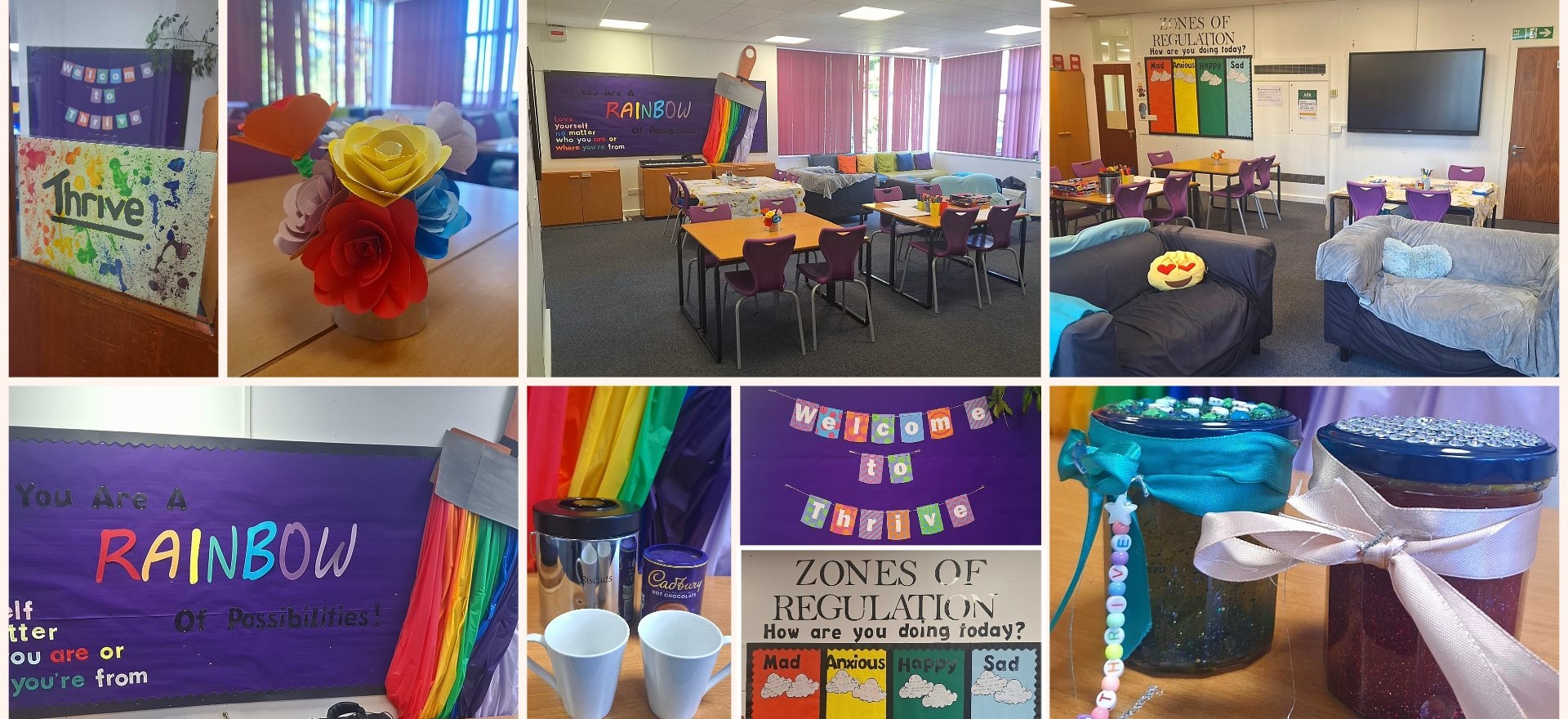
Our Thrive Room and Thrive Activities
The Thrive Approach Theory – PACE
All staff at Tudor Grange Academy schools understand the importance of building positive, supportive relationships with pupils and this is embedded by always using a PACE approach.
PACE is a way of relating to others or ‘a way of being’, paying attention to how we deliver messages to children and young people through our communication. It offers a way in which we can attune and strengthen relationships with them.
Playfulness
Displaying lightness and a feeling of optimism through your energy, body, face, and voice; exaggerating the expression of emotion in body, face and voice – with sensitivity; showing that you are available through open expressions and gestures; creating opportunities for reciprocal enjoyment to build a sense of camaraderie and trust.
Acceptance
Acknowledging the child or young person and their emotional state as being true and valid; reflecting this back to them to communicate your understanding and willingness to accept them and their feelings.
Curiosity
Taking a deep interest in understanding the experience of the child or young person and their feelings from their perspective. Being open, non-defensive and non-judgemental and being accepting of negative emotions without disconnecting or dysregulating.
Empathy
Understanding the perspective of the child or young person in any situation, including if it is painful or conflicted, and staying with this, so that the child or young person feels safe and understood.
The Thrive Approach Theory – VRF’s
When children and young people are dysregulated or are displaying fight/flight or freeze/faint responses, it is the role of the adult to help them back into their window of tolerance and open their social engagement system. We cannot reason, rationalise or address behaviour with a child or young person when they are dysregulated.
To do this, we use Vital Relational Functions (VRFs).
Attune – Catch and match the child or young person’s feelings. Use body language and facial expressions to show that you are aware of how the child or young person feels.
Validate – Help to stop the behaviour by validating the feeling. Let the child or young person know that it is ok to have this feeling.
Contain – Make the unbearable survivable. Listen, do not lecture. Be alongside them to support them.
Regulate – Meet the intensity of how the feeling impacts the child or young person, calm and soothe or stimulate, depending on presentation, in order for them to come back into their social engagement system.
Thrive Sessions
Research in child development and neuroscience has shown that children’s social and emotional development occurs sequentially and that at each Thrive strand, there are key developmental tasks that children need to meet. If interruptions occur at the age when these tasks should be explored and developed, children may need support to revisit these tasks at a later age. This work is known a reparative and is carried out with a licensed Thrive practitioner through weekly 1:1 or group sessions.
Thrive Approach Developmental Framework
|
Being (0 – 6 months) |
Being Safe |
|
Having needs met |
|
|
Being Special |
|
|
Doing (6 – 18 months) |
Exploring and experimenting |
|
Experiencing Options |
|
|
Initiating, engaging and doing |
|
|
Thinking (18 months – 3 years) |
Expressing a view |
|
Feeling, thinking and problem solving |
|
|
Learning about cause and effect |
|
|
Power and Identity (3 – 7 years) |
Developing an identity |
|
Distinguishing between fantasy and reality |
|
|
Exploring power with responsibility |
|
|
Skills and Structure (7 – 11 years) |
Motivation for developing skills |
|
Developing morals and values |
|
|
Understanding the need for rules |
|
|
Interdependence (11 – 25 years) |
|
Will my child receive Thrive support?
We use Thrive as a whole school approach, however in some cases tailored 1:1 or group sessions may be arranged to support student’s social and emotional development and carry out reparative work mentioned above.
Our Thrive practitioners carry out whole class Thrive assessments twice in students’ first year with us which indicate if there are any students that may benefit from weekly tailored support using Thrive Online action plans.
Any students who present a greater need for support due to their behaviour, social or emotional needs in school will be individually assessed through a Thrive behaviour assessment by our Thrive Practitioners to create a tailored Thrive action plan and be timetabled to receive additional support as necessary.
Please see ‘Thrive Assessments Action Plans’ document above for more information about our Thrive assessment process.