Science
Skill
Studying science is key to being able to understand the world around you from the miniscule to the massive! The importance of science knowledge, both in and outside the curriculum, is becoming more evident as we are starting to tackle environmental and health issues of the current times.
Regardless of pathway, students’ knowledge and skills will be developed to enable them to become adept scientists – students who are able to problem solve and eloquently discuss the world they live in.
Criticality
Science is the systematic study of the structure and behaviour of the physical and natural world through observation and experiment. We foster curiosity in our students and teach them to generate hypotheses and systematically gather evidence. Scientists can solve problems logically, apply reasoning, work both in a team and independently and can communicate their ideas clearly.
Science also allows for students to evaluate cause and effect and determine the implications beyond the scientific theory they understand. The ability to listen to opposing views and create rational arguments is vital to students developing the ability to empathise with others.
Character
Due to the cross disciplinary nature of the subject: students will continue to hone both their literacy and mathematical skills. The study of science aims to develop systematic and logical thought to enable students to explain observations and solve problems. This will mean that students will need to develop resilience as they are exposed to increasingly more difficult and complicated concepts as they progress through their science career in school.
Experience
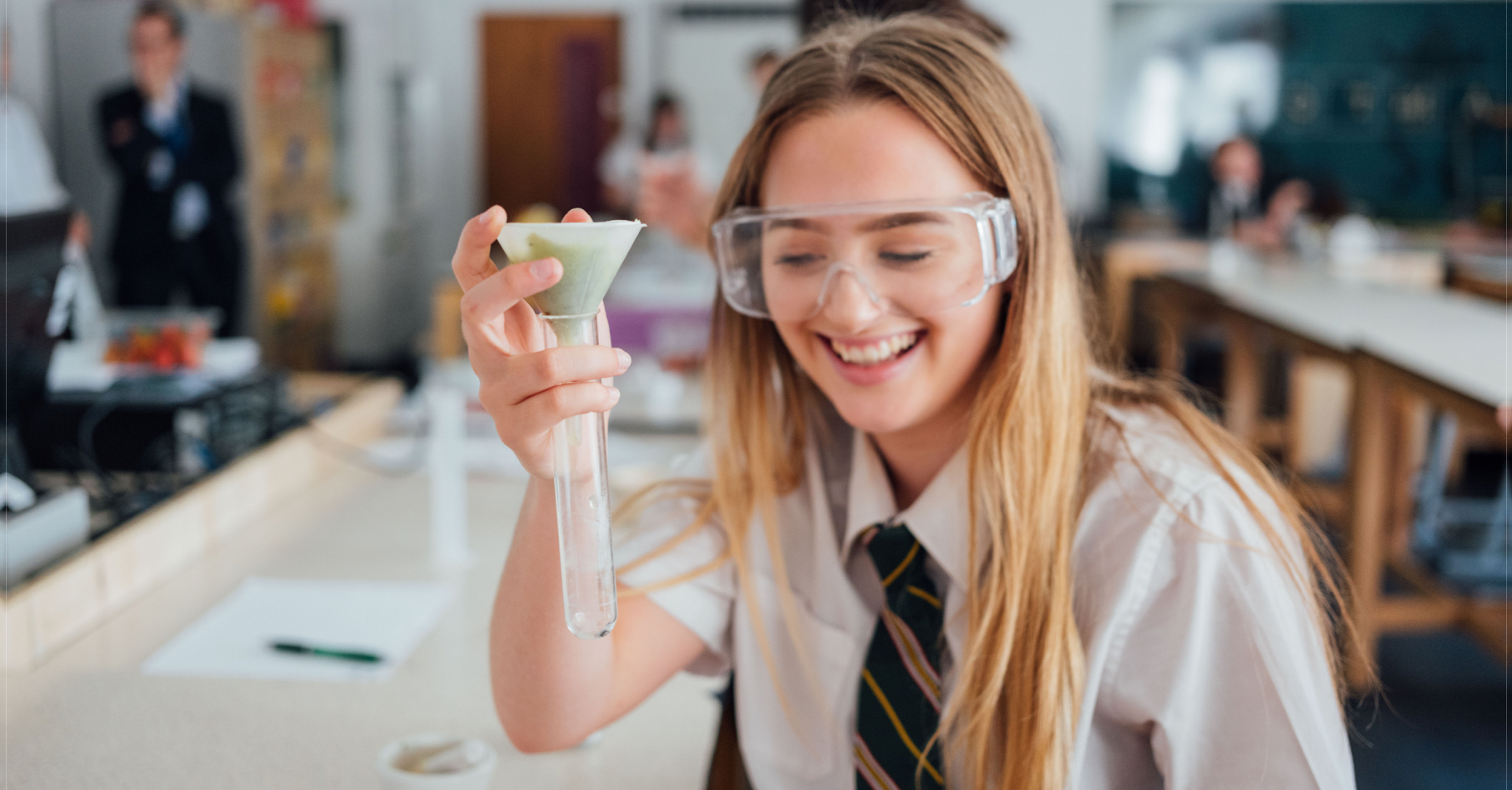
The science curriculum links closely in many areas with the PSHE curriculum and allows content covered in PSHE to be further explored. Every student will have the opportunity to take part in a variety of science related activities with a particular emphasis on practical investigation and the conclusions that can be drawn from it. They will be encouraged to question how the world works and to use their scientific knowledge to find explanations. We take pride on ensuring that students lessons are developed to relate their applications both in and outside the curriculum – for example in industry. Scientific thinking involves applying scepticism to ideas and forming testable hypotheses. This type of thinking can lead to experiments, and it can help people develop skills for determining whether something they hear or see is true. Scientists are trained to only trust what is supported by evidence, so scientific thought requires not believing something unless it is supported with proof. Science, however, also requires creativity, so scientific thinking includes determining means of testing specific ideas to prove them true or false. In many cases, people who think in a scientific manner are able to devise experiments to test hypotheses to determine which, if any, are true.
Curriculum Map
